 A distributor I know lost a six-figure hospital contract last spring because of a seam.
Not the fabric. Not the zipper. Not the price. The seam. The coveralls passed the fabric test with flying colors, the samples looked great, and the first two container loads shipped without a complaint. Then a nurse in a triage ward bent over to tie a shoe and felt the tape lift along her shoulder. One complaint turned into a random lab pull, which turned into a failed water penetration test, which turned into a recall and a very unpleasant phone call with a procurement director who does not take second chances.
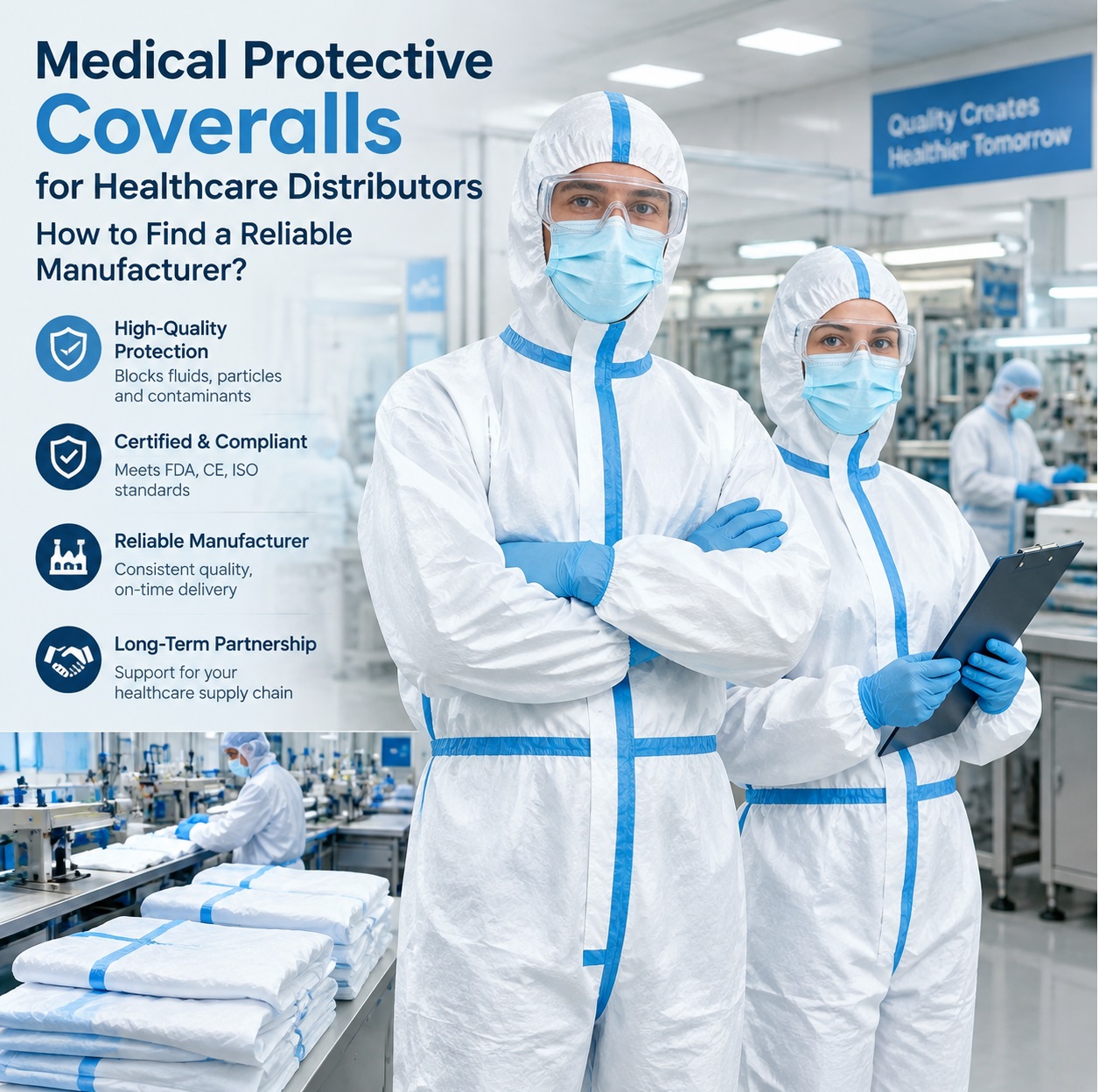
That story is the whole reason this article exists. If you sell medical protective coveralls, your business lives or dies on the manufacturing partner behind the label. And finding a good one is less about charm and catalogs than about knowing exactly where the shortcuts hide.
Start With the Paper Trail, Not the Price List
Every serious coverall manufacturer will hand you a stack of documents. The question is whether you can read them.
The baseline for most export markets is CE certification under the PPE Regulation, which means a Type rating tested to EN 13982 (Type 5, particle protection), EN 13034 (Type 6, light liquid splash), EN 14605 (Type 3 and 4, liquid-tight and spray-tight), and EN 14126 for protection against infective agents. Type 3 and Type 4 are the ones hospitals actually care about when there is blood, vomit, or aerosolized anything involved. Type 5 and 6 are lighter-duty and cheaper, and plenty of distributors get themselves into trouble by marketing a Type 6 as if it were a barrier against infectious liquids. It is not. Do not let your sales team blur that line.
Ask for the EU type-examination certificate from a notified body, the current Declaration of Conformity, and the full test reports — not a summary page, the full reports. Check the notified body number against the EU NANDO database. Check that the model numbers on the certificate match the model numbers on your purchase order. I have seen certificates for a discontinued model quietly reused for a new one, and the manufacturer acted like it was a clerical detail.
If you sell into the United States, the picture is different. Coveralls marketed as PPE fall under OSHA and NIOSH considerations, while surgical gowns and certain barrier apparel fall under FDA review. Know which category your product actually sits in before you print a single box.
The Seam Is Where Cheap Coveralls Go to Die
Here is the test that separates real factories from assemblers: cut a coverall open along the seam and look at how the panels are joined.
Serged seams are stitched and cheap. Bound seams fold fabric over the stitch. Taped seams — the ones that matter for Type 3 and Type 4 — have a heat-sealed tape running the full length of every join, including around the zipper flap and the hood attachment. That tape is applied by a machine that costs real money, run by an operator who needs real training, at a speed that is slower than everyone would like.
So when a quote comes in 30 percent below the competition on a taped-seam coverall, something has been sacrificed. Maybe the tape is narrower. Maybe it is glued instead of heat-sealed. Maybe it is only applied to the visible seams and skipped at the crotch and underarm, which is exactly where a healthcare worker stretches and where failures show up. Ask for a seam sample, then soak it, then pull it. Or better, send it to a third-party lab and pay the two hundred dollars. It is the cheapest insurance you will ever buy.
Factory or Trading Company? Ask These Questions
Half the “manufacturers” you meet at a trade show are trading companies with a nice booth and a WeChat account. That is not automatically a dealbreaker — good trading companies exist and they can handle logistics beautifully — but you should know who you are actually dealing with, because it changes your leverage, your lead times, and your ability to fix problems.
Ask where the coveralls are made. Ask for the address and the business license. Ask how many seam-sealing machines they run and how many shifts. Ask what happens when a roll of fabric fails the incoming inspection. Ask to see the QC log from last Tuesday. Trading companies stumble on the specifics; factories answer without thinking.
Then do the audit. Not a video tour with a smiling manager walking past three clean tables. A real audit, either by your own person or a third-party firm, that checks the fabric warehouse, the cutting floor, the sealing stations, the inspection room, and the finished goods area. Look for fabric with no traceable lot numbers. Look for sealing machines that are idle because nobody knows how to set the temperature. Look for workers sealing without gloves and eye protection — if they do not protect themselves, they will not protect your brand.
Sample Before You Sign, and Sample Again After
Order samples. Wear them. Have someone in a hospital environment wear them. Then order a second round from the production line, not from the sample room, and compare. Sample rooms produce beautiful coveralls. Production lines produce reality.
Put the samples through the tests that match your claims: hydrostatic head, synthetic blood penetration, particle filtration, tensile strength on the seam. If the manufacturer resists third-party testing or insists on using “their” lab, that is your answer. A confident factory will happily send material to whichever lab you choose.
Capacity Conversations Are Usually Lies Until They Are Not
Every supplier claims to make 200,000 coveralls a month. During ordinary times, that number is often inflated. During a respiratory outbreak, it becomes pure fiction as every government on earth starts buying at once.
Ask about surge capacity in concrete terms. How many additional sealing machines can they bring online, and how fast? Where does the fabric come from — do they buy from one mill or three? What is their safety stock of raw material? What happened to their lead times in the last major demand spike, and can they show you the shipping records to prove it?
A manufacturer who says “we can double output in three weeks, and here is how” is worth ten who say “no problem, we can do anything.”
Watch the Price, Then Watch the Price Again
Fabric is the single biggest cost driver in a coverall. When oil prices move, so does the price of polypropylene and the SMS and microporous films used in barrier fabrics. A manufacturer who refuses to explain their fabric composition — grams per square meter, layer structure, whether it is SMS, SMMS, or a film laminate — is hiding something. So is one whose price never moves at all, because that usually means the fabric is being swapped quietly behind your back.
Lock pricing to a formula you understand, with a stated fabric specification attached. Re-test whenever the price drops without explanation.
Build the Relationship Before You Need It
The distributors who survived 2020 with their reputations intact were the ones who had already invested in their manufacturing relationships — visiting the factory, paying on time, communicating honestly about forecasts, and not squeezing the last half-cent out of every order.
Pick two manufacturers, not one. Split your volume. Keep a third qualified and audited as a backup. Yes, that costs a little more. It costs a lot less than explaining to a hospital network why their order is six weeks late.
And when you find a factory that tapes its seams properly, tests its fabric, keeps its paperwork straight, and answers the phone when something goes wrong — treat them like the asset they are. In this business, a reliable manufacturer is not a vendor. It is the reason your brand still means something.